How to Standardize Payment Processes Across Multiple Business Units
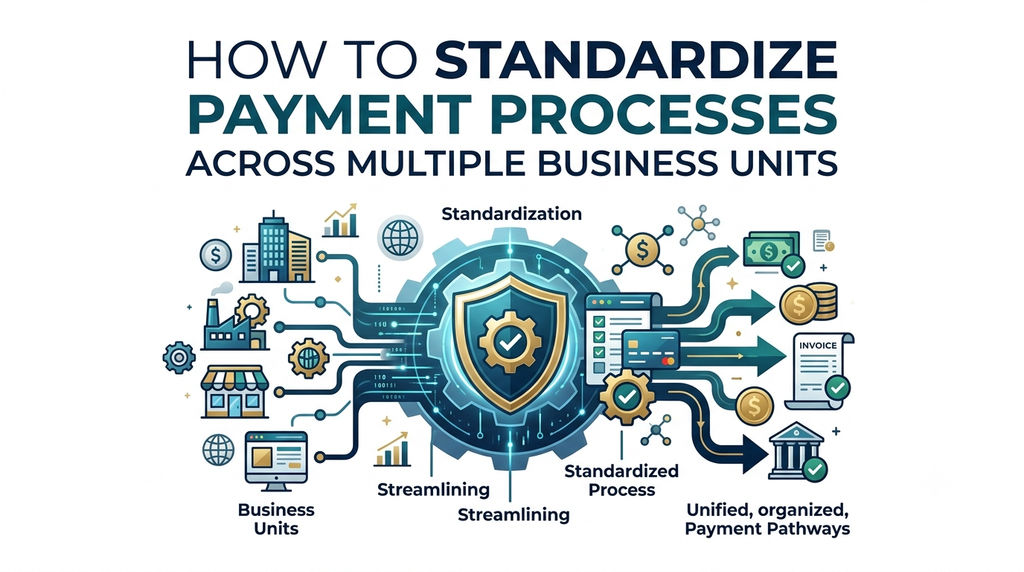
When a company grows through expansion or acquisition, each business unit often builds its own way of paying vendors and collecting money. One division might approve invoices by email and pay via wire transfer, while another relies on spreadsheets, checks, or local payment links. That works fine at small scale, but once you have several operating units, fragmented habits turn into real financial drag.
Standardizing payment processes across multiple business units does not mean forcing every team into a rigid straightjacket. It means creating a shared set of rules, approval thresholds, data formats, and reconciliation steps that work across the entire organization—while leaving room for genuine local or operational needs.
Why Fragmented Payment Workflows Slow Down Growing Companies
Unstandardized payments rarely fail all at once. Instead, they create quiet friction across finance, procurement, and operations:
- Inconsistent approval control: When one business unit requires two sign-offs above a set dollar amount and another lets managers approve anything informally, internal controls become uneven.
- Duplicate or missed invoices: If shared vendors bill different divisions under slightly different names or cost codes, teams can pay the same invoice twice—or miss early-payment discounts because approvals sit in someone’s inbox.
- Slow month-end close: Finance teams spend extra days matching bank statements to ledger entries when every unit codes transactions differently or uses separate payment tools.
- Higher fraud and compliance exposure: Scattered sign-off habits make it harder to spot altered bank details, enforce vendor verification, or maintain clean audit trails across jurisdictions.
Start With a Map of What Actually Happens Today
Before you write a new policy or roll out software, look at how payments actually move right now. Policies often describe what leaders think happens rather than what staff do on a busy Tuesday.
Gather a sample of recent outbound and inbound transactions from each business unit. Track five details for each:
- How the request or invoice enters the system.
- Who approves it, and how that approval is recorded.
- Which payment rail or collection method is used (such as ACH, wire, card, check, or payment link).
- How the entry is coded to general ledger accounts and cost centers.
- How and when reconciliation happens against bank activity.
You will usually spot quick wins right away—such as three units using different naming conventions for the same supplier or two teams manually re-keying data that already exists in a purchase order.
Decide Where Rules Must Be Uniform and Where Flexibility Belongs
A common mistake in multi-entity payment standardization is treating every difference as a problem to eliminate. Tax rules, local banking rails, currencies, and industry billing habits can legitimately vary by region or business line.
A practical approach splits your payment framework into two layers:
| Layer | What Gets Standardized | Where Local Flexibility Fits |
| Governance & Controls | Approval tiers, segregation of duties, vendor bank-change verification, audit logging | Secondary sign-off roles based on local org charts |
| Data & Coding | Required invoice fields, tax/cost-center tags, payment status definitions | Region-specific tax IDs or statutory reporting fields |
| Execution Rails | Preferred electronic payment channels and cutoff schedules | Local clearing rails, currencies, or customer-preferred collection methods |
| Reconciliation | Matching cadence, exception-handling rules, close checklists | Bank account structure or local FX settlement timing |
This balance helps teams adopt the new process instead of working around it. If a local unit cannot pay a regional supplier using a rule built for a different country, staff will invent side channels—and your visibility drops back to square one.
Build a Shared Approval and Payment Policy
Once you know where standardization matters most, document a clear payment governance baseline that every business unit can read and follow without guesswork.
Keep the policy practical and specific:
- Set clear dollar thresholds: Define who can approve routine expenses, mid-size invoices, and high-value commitments, and spell out what happens when an approver is out of office.
- Separate duties cleanly: The person who adds or edits a vendor’s bank details should not be the same person who approves an invoice or releases the payment.
- Standardize payment timing: Establish predictable payment runs and cutoff times so business units know when invoices must be approved to make a scheduled batch.
- Define exception handling: Spell out how teams handle rush requests, disputed charges, partial shipments, or mismatched purchase orders so exceptions do not become the norm.
Align Data Standards Before Automating Tools
Software magnifies whatever process you feed into it. Moving five business units onto a unified payment platform without cleaning up data standards often shifts the mess into a new interface.
Focus on invoice and payment reconciliation readiness by standardizing:
- Vendor master records: Merge duplicate vendor profiles, enforce consistent legal names, and require formal verification before changing payout details.
- Chart of accounts mapping: Make sure expense categories and cost centers mean the same thing across units—or map cleanly to a single reporting structure.
- Reference fields: Require purchase order numbers, invoice numbers, or customer reference IDs on every transaction so automated matching has clean keys to work with.
Roll Out in Waves and Measure What Improves
Trying to switch every business unit over on the same weekend can overwhelm support teams and stall operations. A phased rollout lets you test assumptions in the real world and fix rough edges early.
- Pilot with one or two cooperative units: Choose business units with moderate transaction volume and clear day-to-day pain points.
- Refine workflows with user feedback: Watch where approvals stall, where coding confuses staff, or where exceptions pile up, and adjust instructions before expanding.
- Train by role, not just with a slide deck: Show approvers how to review cleanly, show AP/AR staff how to resolve exceptions, and give managers simple visibility into pending items.
- Track concrete operational metrics: Monitor approval turnaround time, duplicate or late payment rates, unapplied or unmatched items, and days to close reconciliation.
Standardizing payment processes across business units is an ongoing operational habit rather than a one-time project. When your core controls, clean data rules, and reconciliation steps stay consistent across every unit, finance gains clearer cash visibility—and every business unit spends less time chasing paperwork.
Frequently Asked Questions
How long does it take to standardize payment workflows across multiple business units?
Timelines depend on how many entities you have, how different their current tools are, and whether you are changing software at the same time. Many organizations map workflows and align core approval and coding rules within a few weeks, then roll out execution changes across units in phases over one to three quarters.
Should every business unit use the exact same bank account?
Not necessarily. Keeping separate accounts can make sense for distinct legal entities, foreign currencies, local tax rules, or ring-fenced funds. What matters most is standardizing how transactions are coded, approved, and reconciled across those accounts so leadership still gets a unified view.
What is the biggest risk when standardizing payments across divisions?
Over-standardizing local operational details—such as forcing a single payment rail that does not fit regional banking or customer preferences—often pushes staff back into manual workarounds. Keeping core controls and data uniform while allowing sensible local execution helps avoid resistance.
Can we standardize approvals before adopting new payment software?
Yes, and doing so first usually makes any tool rollout smoother. Agreeing on approval tiers, segregation of duties, vendor verification checks, and required invoice data clarifies what you actually need from software and prevents automating broken habits.
Conclusion
Standardizing payment processes across multiple business units works best when you treat it as a practical operating habit rather than a one-time rule change. Start by mapping how payments actually move today, keep core controls and data rules consistent, and leave room for genuine local needs so teams do not rely on workarounds. Over time, cleaner approvals and steady reconciliation give finance clearer cash visibility while letting every business unit focus on its core work.
Try it on your own invoices
Create GST invoices, share secure links and PDFs, and collect via Paytm payment links, UPI or bank transfer with PayManagerPro.