Starting a Payment Operations Function: Workflows, Roles, and Controls
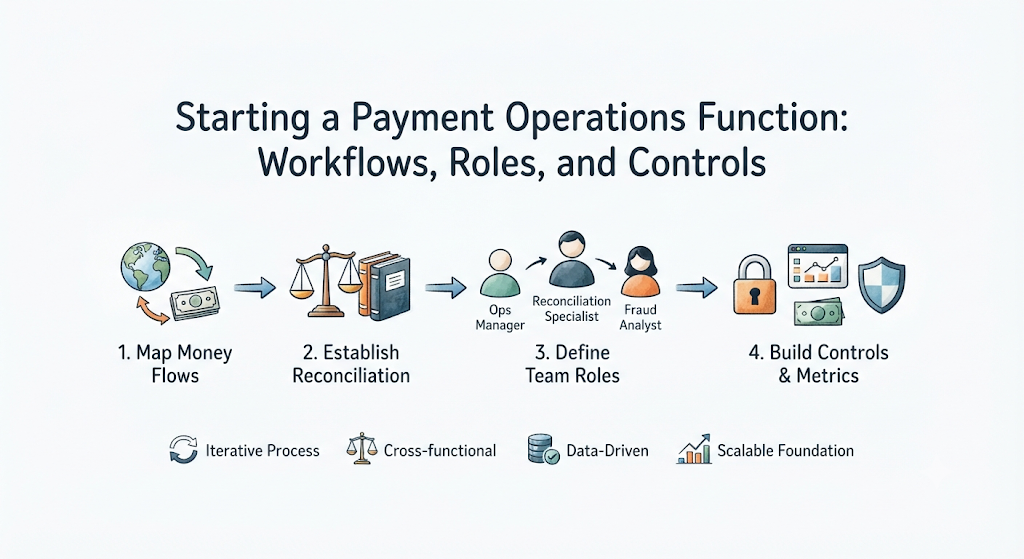
In many growing businesses, payment operations starts as an accidental side job. An engineer integrates a payment gateway, a finance manager downloads CSV files at the end of the month to match payouts against bank deposits, and a customer support agent handles refund requests one ticket at a time. That informal setup works until transaction volume climbs, payment methods multiply, or a settlement discrepancy freezes cash flow.
Building a dedicated payment operations function shifts a company from reacting to payment failures to managing money movement intentionally. Rather than treating payments as a passive background utility, a structured payment operations (PayOps) team connects engineering, finance, risk, and customer support so funds move accurately, predictably, and safely.
What Payment Operations Actually Owns
Before hiring staff or buying software, leadership needs a clear boundary around what payment operations does—and what stays with adjacent departments. Payment operations sits at the intersection of technical payment routing and financial accounting.
While core product engineers build the checkout interface and corporate accounting closes the general ledger, payment operations manages the operational lifecycle of every transaction between authorization and final settlement.
| Core Domain | Key Responsibilities | Primary Collaborators |
|---|---|---|
| Transaction Lifecycle Management | Monitoring authorization rates, configuring payment routing, managing retries, and troubleshooting declines | Checkout Engineering, Payment Gateways |
| Reconciliation and Settlement | Matching internal order records against processor settlement reports and bank statements | Accounting, Treasury |
| Dispute and Refund Handling | Managing chargeback representment, tracking win rates, and governing refund workflows | Customer Support, Fraud/Risk |
| Partner and Provider Management | Onboarding acquirers, maintaining processor relationships, reviewing fee structures, and monitoring SLAs | Legal, Procurement, Finance |
| Compliance and Operational Controls | Supporting PCI DSS scope management, sanctions screening workflows, and audit trail documentation | Legal, Information Security |
Defining these boundaries early prevents two common organizational failures: engineers getting pulled off product roadmaps to debug missing payouts, and accountants spending days manually investigating penny discrepancies in processor files.
Phase 1: Map Your Current Money Flows
You cannot optimize or automate a payment system you cannot see end to end. The first practical step in establishing payment operations is creating a complete map of how funds enter, move through, and leave the business.
Start by documenting every payment rail and provider currently active across your business units:
- Pay-in channels: Credit and debit card processors, digital wallets, ACH or SEPA bank transfers, real-time payment networks, and alternative local payment methods.
- Payout channels: Vendor disbursements, marketplace seller payouts, payroll processors, and customer refund rails.
- Currency and entity flows: Which legal entities collect funds, where currency conversion occurs, and which bank accounts receive net settlements.
For each flow, trace the exact lifecycle states: initiated, authorized, captured, settled, refunded, disputed, and paid out. Pay close attention to timing gaps. A card transaction might authorize in two seconds, capture upon shipment two days later, settle net of interchange fees three days after that, and appear on a bank statement under a batch reference ID that bears no resemblance to the original customer order number. Documenting those data handoffs reveals where visibility breaks down.
Phase 2: Establish Daily Reconciliation Before Scaling Volume
If a new payment operations function only builds one core discipline first, it should be automated, repeatable reconciliation. Without reliable reconciliation, finance teams cannot trust revenue numbers, and operational teams cannot spot silent failures such as uncaptured authorizations or missing settlements.
A sound payment reconciliation process operates across three distinct layers rather than relying on a single monthly bank check:
- Order-to-Processor Matching: Verifying that every successful order in your internal database has a corresponding captured transaction in your payment service provider (PSP) records.
- Processor-to-Bank Matching: Confirming that the net settlement batches reported by each PSP actually land in your corporate bank accounts, accounting for processing fees, rolling reserves, and refunds.
- Exception Resolution: Routing unmatched records, partial captures, duplicate charges, or unexpected fee deductions into a structured queue with clear ownership and resolution timelines.
When building this from scratch, avoid relying on manual spreadsheet lookups once daily transaction counts pass a few hundred. Even before investing in enterprise reconciliation platforms, standardizing a unique correlation ID across your checkout system, PSP metadata, and internal ledger makes matching dramatically easier.
Phase 3: Build Core Operational Controls and Metrics
Once money flows are mapped and reconciled, payment operations needs objective indicators to measure performance and catch anomalies early. Relying solely on customer complaints to discover a broken payment route or an expired gateway credential leads to avoidable revenue loss.
Focus initial monitoring on a focused set of operational metrics:
- Authorization Rate: The percentage of submitted payment requests approved by issuing banks, segmented by card brand, country, and processor. Sudden drops often signal issuer rule changes, formatting errors in payment payloads, or overly aggressive fraud filters.
- Settlement Variance: Any unexplained difference between expected net payouts and actual cash received in bank accounts.
- Chargeback Ratio: Disputed transactions divided by total transactions, tracked against card network thresholds (such as Visa and Mastercard monitoring program limits) to prevent fines or account termination.
- Effective Cost of Payments: Total processing fees—including interchange, scheme fees, gateway markups, and cross-border assessments—divided by total processed volume.
- Time to Resolution for Exceptions: How quickly operational staff investigate and close failed payouts, stuck refunds, or reconciliation breaks.
Alongside metrics, establish dual-control approvals for high-risk actions. Manual refunds above a set dollar threshold, payout bank account changes, and manual ledger adjustments should always require review by a second authorized team member.
Phase 4: Structure the Team as Volume Grows
Hiring an entire department on day one rarely makes sense. Instead, scale payment operations talent in stages aligned with operational complexity.
Stage 1: The Founding Payment Operations Generalist
At early growth stages, one dedicated Payment Operations Manager or Lead can own vendor coordination, reconciliation oversight, chargeback workflows, and operational requirements for engineering. Look for someone who can read API documentation and SQL queries just as comfortably as a processor settlement statement.
Stage 2: Functional Specialization
As transaction volume expands across multiple regions, currencies, or payment methods, split daily execution from strategic improvement:
- Payment Operations Analysts: Focus on daily reconciliation exceptions, dispute evidence preparation, payout monitoring, and merchant account operations.
- Payment Product or Technical Specialists: Partner with engineering to implement smart routing, network tokenization, account updaters, and new local payment methods.
- Risk and Compliance Coordinators: Manage know-your-customer (KYC) renewals, processor underwriting requests, and PCI compliance documentation.
Stage 3: Dedicated Payment Engineering Alignment
At high scale, payment operations works alongside a dedicated payments engineering pod. Payment operations brings empirical data on decline codes, fee structures, and operational bottlenecks, while engineers build internal ledgers, automated retry logic, and multi-processor orchestration.
Phase 5: Manage Payment Providers Like Critical Infrastructure
Many businesses treat payment gateways as “set-and-forget” software vendors until an outage halts checkout or an unexpected reserve holds back working capital. A mature payment operations function manages providers proactively.
Keep a centralized vendor registry tracking contract renewal dates, pricing schedules, reserve terms, settlement timelines, and technical escalation contacts. Schedule quarterly business reviews with primary processors to review authorization performance, discuss upcoming card network rule updates, and audit effective processing rates against contracted pricing.
When adding secondary processors for redundancy or geographic expansion, weigh the operational overhead carefully. Every additional provider introduces a new settlement file format, a separate dispute portal, and distinct API error codes. Multi-processor setups deliver resilience and routing flexibility, but only when your reconciliation and monitoring infrastructure can absorb the added complexity.
Frequently Asked Questions
How is payment operations different from corporate accounting?
Corporate accounting focuses on recording financial activity accurately in the general ledger, closing financial periods, and preparing financial statements. Payment operations manages the real-time operational mechanics of moving money—optimizing authorization rates, resolving gateway errors, managing disputes, and reconciling granular transaction files so accounting receives clean, verified data.
When should a company hire its first payment operations specialist?
Most companies reach the tipping point when payment troubleshooting regularly interrupts engineering sprints, monthly reconciliation takes finance several days of manual work, or expansion into new markets introduces unfamiliar payment methods and currencies. Hiring before a major regulatory audit or peak seasonal volume spike prevents costly operational bottlenecks.
Should you build an internal payment ledger from scratch or use third-party tools?
Smaller businesses with straightforward single-processor setups can often rely on PSP reporting combined with accounting software integrations. Once a business handles multi-party payouts, held funds, multiple processors, or high daily transaction volumes, implementing a dedicated double-entry internal ledger—either built in-house or via specialized ledger software—becomes essential for accurate tracking.
How does payment operations work with fraud and risk teams?
Fraud teams focus on blocking unauthorized transactions and bad actors before funds are lost, while payment operations ensures legitimate transactions clear smoothly and funds settle accurately. Close collaboration prevents overly strict fraud rules from blocking good customers and ensures chargeback data feeds back into fraud prevention models.
What technical skills are most useful in a payment operations role?
Strong payment operations professionals combine financial literacy with practical data skills. Familiarity with SQL for querying transaction logs, experience reading REST API documentation and webhook payloads, proficiency in spreadsheet modeling, and a clear understanding of card network clearing and settlement cycles are among the most valuable capabilities.
Turning Payments Into a Reliable Operational Advantage
Building a payment operations function does not require overhauling your entire financial stack overnight. By starting with clear ownership boundaries, mapping every money flow end to end, and locking down daily reconciliation before layering on complex routing or new providers, you create a foundation that scales cleanly. As transaction volume grows, that discipline protects revenue, keeps financial reporting accurate, and turns payment infrastructure from a recurring headache into a dependable business asset.
Try it on your own invoices
Create GST invoices, share secure links and PDFs, and collect via Paytm payment links, UPI or bank transfer with PayManagerPro.